Living Design for Organizations
Grow the capacity to navigate complexity, find leverage, and bring consequential things to life.
Organizations often struggle because the challenge lives in the system around them.
Information isn’t flowing. Knowledge is concentrated in a few people. Resources aren’t connected to where they could create value. Responsibilities are unclear or concentrated. Partners are working toward related goals without coordinating.
A constraint in one part of the system limits possibilities everywhere else.
Working harder or controlling more won’t necessarily change the outcome.
Living Design helps organizations see possibility differently, so they can change the conditions in which it grows.
❋
October 3-7 | Starting at $500What is Living Design?
Living Design is a structured way of seeing and working with complex systems, grounded in the patterns through which life has adapted, organized, cooperated, and created possibility for billions of years.
Evolutionary biologist and biomimicry author Dr. Tamsin Woolley-Barker brings together evolutionary biology, biomimicry, living systems, collective intelligence, cooperation, organizational design, and multicapital thinking to help organizations ask better questions about the systems they are trying to change.
Ways to work together
Living Design engagements can begin lightly or go deeply into a consequential organizational challenge.
Each offering stands on its own. They can also build upon one another as the work reveals where greater capacity or deeper intervention would create value.
Keynotes + Interactive Talks
Inspire possibility. Change how people see.
Introduce your organization to the patterns that allow living systems to coordinate, adapt, cooperate, and become more capable.
Drawing on evolution, biomimicry, collective intelligence, and stories from nature and organizations, these sessions explore what billions of years of living systems can teach us about navigating uncertainty, working with constraints, distributing intelligence, and growing possibility.
Presentations can be tailored around the challenges and opportunities your organization is facing.
Useful for: leadership gatherings, conferences, staff events, board meetings, innovation programs, retreats, and organizational learning.
Outcome: A shared language and new lens for seeing the organization, its challenges, and possibilities that may already be present in the system.
Living Design Workshops
Bring a real challenge. Discover opportunity. Find leverage.
Bring a cross-functional group together around something the organization genuinely wants to create, change, or unlock.
Using the Living Design Lens, we explore:
What are we trying to bring to life?
What forces are already in motion?
What is working—and what is getting in the way?
What capacities need to develop?
What relationships, resources, or forms of capital might we be overlooking?
Where might relatively small changes create outsized effects?
The organization itself becomes the laboratory.
Format: Half-day or full-day, in person or virtual.
Useful for: emerging initiatives, persistent challenges, innovation opportunities, strategic questions, organizational transitions, or problems that cross traditional functional boundaries.
Outcome: A richer map of the challenge, greater clarity about constraints and potential leverage, and promising moves or experiments to explore.
Living Design Labs
Develop the people who navigate complexity inside your organization.
Living Design Labs develop internal capacity by allowing participants to learn Living Design while applying it directly to consequential work.
Participants bring real organizational challenges, initiatives, or opportunities into a structured Living Design process.
They learn to see systems more clearly, recognize constraints and underused capacities, work with multiple forms of capital, identify leverage, design experiments, and adapt based on what happens.
The work is not separate from their jobs.
Their work becomes the laboratory.
Labs can be created for a single organization or include participants from multiple organizations and fields.
Useful for: emerging leaders, innovation teams, cross-functional groups, organizational change leaders, internal consultants, strategists, and people responsible for navigating complex initiatives.
Outcome: Progress on real organizational challenges alongside a transferable Living Design capability that remains inside the organization.
BILD Team + Board Retreats
From talented individuals to collective capacity.
A team is not automatically a system simply because its members sit in the same room.
Living Design retreats help boards and leadership teams understand how different people, capacities, relationships, knowledge, information, and responsibilities can become more capable together.
We explore questions such as:
What are we really here to make possible?
What does each person bring?
Where does knowledge live?
Where are information and responsibility flowing well—and where do they get stuck?
Where is too much responsibility concentrated?
What allows people to take responsibility and grow into it?
What needs to be shared across the organization, and what can remain distributed?
What few constraints may be making many other things harder?
And:
What can we try?
The aim is not another retreat full of good conversations whose flip charts disappear afterward.
We create a bridge:
Retreat → insight → priority → experiment → feedback → adaptation.
Useful for: boards, leadership teams, newly formed teams, organizations undergoing transition, distributed organizations, and groups working to develop greater trust, agency, coordination, and collective intelligence.
Outcome: Stronger relationships, greater clarity about purpose and roles, improved information and responsibility flows, identified leverage opportunities, and practical experiments the team can begin testing immediately.

Living Design Strategy Labs
See the system. Find the constraint. Test what changes it.
Take a significant initiative or organizational challenge through a deeper Living Design process.
A leadership or cross-functional team—and, where useful, external partners—maps the challenge as a living system: its purpose, nested systems, capacities, exchanges, constraints, relationships, and multiple forms of capital.
Together, we look for places where information, knowledge, resources, responsibility, funding, relationships, or decision-making are not flowing as effectively as they could.
Rather than committing immediately to an expensive system-wide solution, we identify leverage and develop practical experiments that allow the organization to learn.
Format: One or two days, with optional preparation and follow-through.
Useful for: strategic initiatives, innovation, organizational redesign, scaling, partnerships, resource flows, persistent bottlenecks, or complex challenges where the solution is not yet obvious.
Outcome: A practical evolutionary strategy with a clearer understanding of the system, identified leverage points, and experiments that can be tested before committing to large-scale change.
Living System Assessments
See what the organization can’t see from inside itself.
Sometimes the first need isn’t another strategy.
It is a clearer picture of the system producing the outcomes you’re experiencing.
A Living System Assessment examines the relationships, capacities, structures, exchanges, resource and information flows, constraints, and patterns underneath a recurring organizational challenge.
The goal is not to produce an exhaustive diagnosis of everything that could be improved.
It is to identify:
What is limiting the system’s capacity—and where might intervention create disproportionate value?
Depending on the challenge, the assessment may include leadership conversations, stakeholder interviews, document review, mapping, workshops, and observation.
Useful for: recurring organizational problems, stalled initiatives, scaling challenges, collaboration breakdowns, concentrated knowledge or responsibility, resource constraints, and situations where previous solutions have treated symptoms without changing the underlying pattern.
Outcome: A Living System map of the challenge, key limiting factors and capacities, potential leverage points, and recommendations for experiments or deeper work.
Custom Living Design Partnerships
Grow the system’s capacity to evolve.
Some challenges cannot be meaningfully addressed in a workshop.
They cross departments, organizations, sectors, communities, or places.
A longer-term Living Design partnership works with the actual system over time.
That might mean strengthening distributed leadership inside an organization.
Developing a network of partners around a shared purpose.
Rethinking how knowledge or resources flow.
Growing the capabilities required for a major transition.
Developing a new initiative while simultaneously developing the ecosystem that can support it.
Or working across organizations to ask:
What could this system become capable of that none of its members could accomplish alone?
For place-based work, the process may grow around a Nature of Place Inquiry:
What are the particular ecological, social, cultural, and economic patterns of this place?
What sources the resources and nutrients this community depends upon?
What relationships and exchanges sustain it?
What’s possible?
What would have to be true?
And what new capacities would have to develop?
The engagement evolves with the system itself:
See → find leverage → experiment → learn → build capacity → adapt.
Outcome: Greater capacity within the organization or ecosystem to coordinate, learn, adapt, activate resources, distribute intelligence, and continue evolving without permanent dependence on an outside consultant.
What changes?
The goal of Living Design is not to leave you with an elegant diagram of your organization.
It is to make the system more capable.
Depending on the engagement, that might mean:
Information reaches the people who need it.
Knowledge survives changes in leadership.
Resources begin flowing toward opportunities that were previously invisible.
People find roles where their capacities create more value.
Responsibility becomes less concentrated.
Partners become more capable of coordinating without central control.
A persistent constraint is removed.
An initiative that had stalled begins moving.
The organization becomes better able to sense, learn, experiment, and adapt.
Possibility grows.
Where do we begin?
You don’t need to know which engagement you need.
Start with the thing your organization is trying to bring to life.
The initiative that isn’t moving.
The transition you’re navigating.
The capability you know you need.
The problem that keeps returning.
The opportunity you can see but haven’t figured out how to unlock.
Then we ask:
What is happening now?
What would you love to have happening instead?
What is getting in the way?
That tells us where to begin.
Start lightly—with a keynote or workshop—or bring a concrete challenge into a Strategy Lab, retreat, assessment, or longer partnership.
There is no requirement to move from one offering to another.
Do enough to create value. Learn what happens. Then decide what the system needs next.
What is your organization trying to bring to life?
Let’s start there.
Dr. Tamsin Woolley-Barker
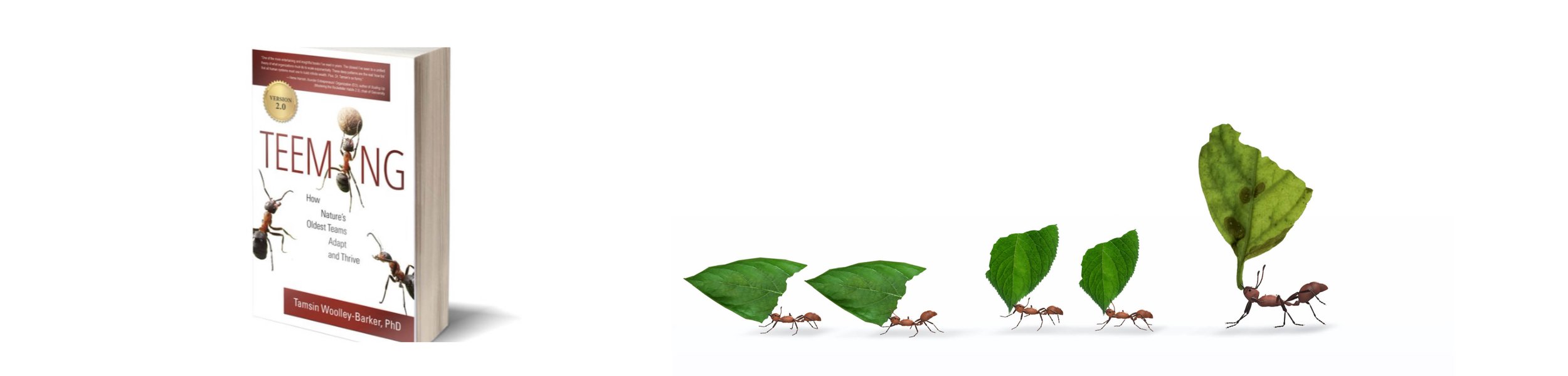
Evolutionary Biologist · Biomimicry Practitioner · Author of Teeming
Founder, Teemlab